Analysis
The iPhone Index: The Same Phone, a Different Effort
The latest iPhone costs about the same in Thimphu as in Sydney. What differs is the effort. A Bhutanese nurse works more than three months for it at home and about six days in Perth. Aspirations are global and pay is local, and that gap is part of what young Bhutanese weigh when they decide whether to stay.
13 November 2026 · 8 min read
On this page · 7 sections
The iPhone may be the nearest thing the world has to a shared aspiration. To many it is the epitome of human creativity and engineering, and it is wanted in Thimphu as it is in Sydney, Singapore and New York. It also costs about the same in all of them.
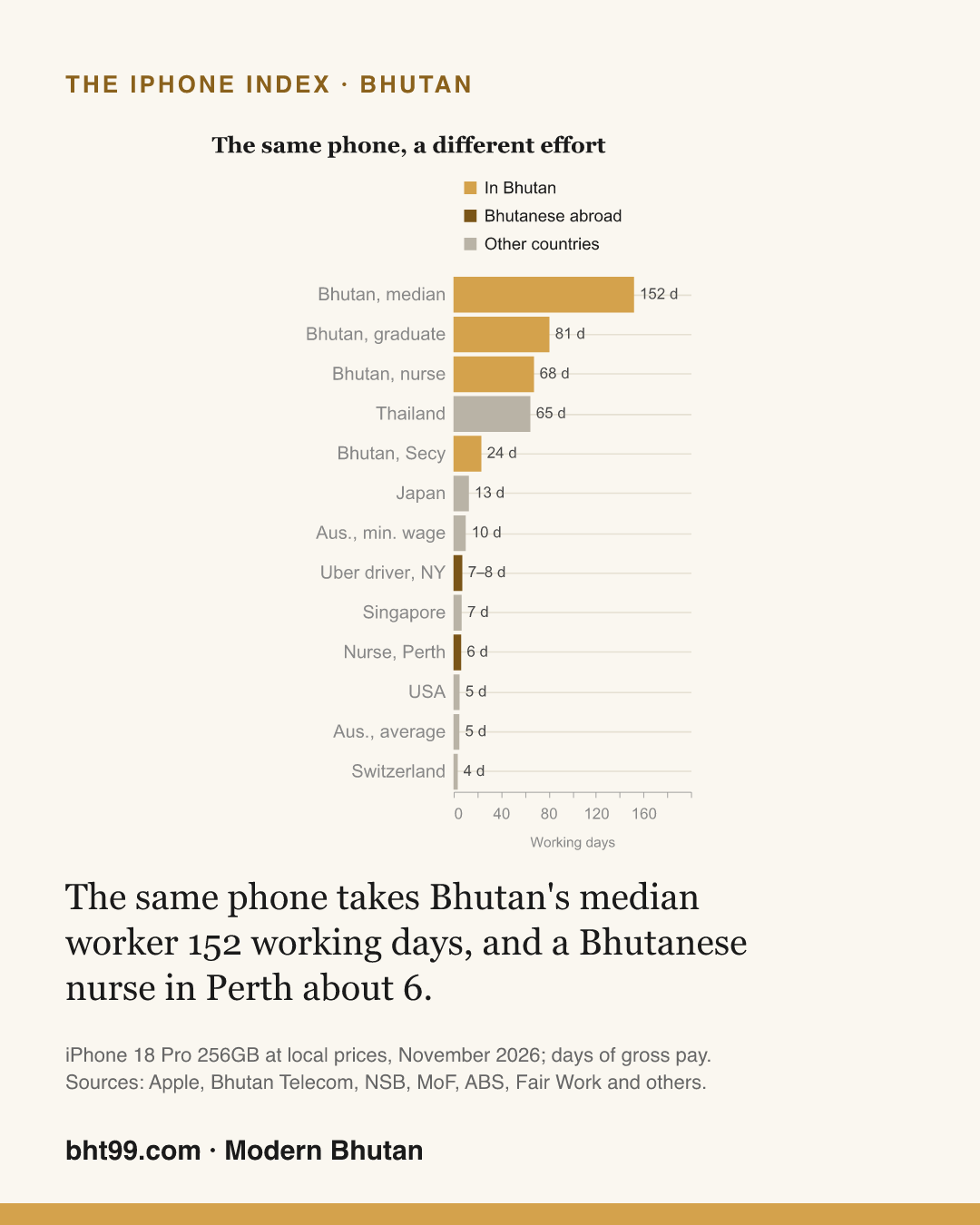
What differs is the effort. The same phone takes a Bhutanese registered nurse in Perth about six days of work. It takes a nurse in Bhutan more than three months.
Aspirations are global. Pay is local. Unless that difference is understood, by those who set pay and by the young themselves, Bhutan’s young people may keep leaving.
One phone, nearly one price
The current model is the iPhone 18 Pro. With 256GB of storage, it costs:
| Where | Local price | In US dollars |
|---|---|---|
| United States | $1,199 before sales tax | about 1,290 with average sales tax |
| Japan | ¥219,800 | about 1,390 |
| Australia | A$2,099 | about 1,450 |
| Singapore | S$1,899 | about 1,480 |
| Bhutan | Nu 144,900 | about 1,540 |
| United Kingdom | £1,199 | about 1,610 |
| Nepal | NPR 259,900 | about 1,730 |
| India | ₹164,900 | about 1,760 |
Prices checked on 10 November 2026, tax included except where shown. Bhutan Telecom lists the phone at Nu 138,000 plus 5% GST; TashiCell and iSpot are within Nu 100 of that.
The phone is about 12% cheaper in Bhutan than in India, and only about 6% dearer than in Australia. Price is not the story.
The effort
Divide the price by what a day of work earns, and the picture changes. This follows the method the shopping site Picodi used for its iPhone Index from 2018 to 2024, which never covered Bhutan: a month’s pay divided by 21 working days. Picodi used average pay after tax; the figures here use pay before tax.
In Bhutan
| Who | Monthly pay | Working days for the phone |
|---|---|---|
| Shop assistants, kitchen helpers, guards | Nu 8,000–12,000 | 254–380 days (12 to 18 months) |
| The median worker | Nu 20,000 | 152 days (about 7 months) |
| A new civil-service graduate | Nu 37,630 | 81 days (about 4 months) |
| A nurse, with the professional allowance | about Nu 44,900 | about 68 days (over 3 months) |
| A Government Secretary | Nu 129,230 | 24 days (just over 1 month) |
Elsewhere
| Who | Working days for the phone |
|---|---|
| India, a salaried employee | 143–189 days (7 to 9 months) |
| Thailand, the average employee | 65 days (about 3 months) |
| Japan, the average employee | 13 days |
| Australia, on the minimum wage | 10 days |
| Singapore, the median full-time worker | 7 days |
| United States, the median full-time worker | 5 days |
| Australia, the average full-time worker | 5 days |
| Switzerland, the median full-time worker | 4 days |
Two things stand out. Bhutan’s median worker, at about seven months, is in the same range as a salaried employee in India. And even a Government Secretary needs more than twice as long as an Australian on the minimum wage.
The same Bhutanese, a different country
The comparison that matters to a young Bhutanese is not with an Australian. It is with themselves, somewhere else.
| The same person | At home | Abroad |
|---|---|---|
| A nurse | about 68 days (over 3 months) | Bhutanese registered nurse, Perth: about 6 days. As an aged-care worker: about 8 days |
| A graduate | 81 days (about 4 months) in the civil service | Bhutanese Uber driver, New York: about 7 to 8 days, after the cost of the car |
The person is the same and the phone is the same. Only the country is different. The catalogue has a name for it: 1 Week at Uber, 6 Months at the Ministry. On today’s figures it is nearer a week and a half against four months.
The scale of the movement is public. The Australian Bureau of Statistics estimated 12,780 Bhutan-born residents in June 2021 and 40,560 in June 2025: more than three times as many in four years.
Even from home, the internet pays by geography
There is one way a young Bhutanese can earn dollars without leaving: an audience. Here too, the place decides the pay.
Kuensel reported in 2022 that a popular Bhutanese YouTube channel earned about USD 200 to 400 a month, where similar content elsewhere earned about USD 1,000. One film channel with 160,000 subscribers earned about USD 200. Advertising is paid according to where the viewers are, and Bhutan was not among the countries where a creator could register to be paid at all; creators registered through Singapore, Australia, India or the United States, and PayPal did not operate in Bhutan. On TikTok, Kuensel found in 2023, creators earned from gifts sent by viewers abroad and withdrew the money through friends overseas.
Getting paid has since become easier. BBS reported in 2023 that YouTubers were receiving their earnings through Google AdSense into local banks, and in 2024 one vlogger described a steady Nu 10,000 a month from her channel.
On those reports, a creator at home earns somewhere between Nu 10,000 and about Nu 38,000 a month. The phone is then 80 to 300 days of work (4 to 14 months): no nearer than it is for a graduate or the median worker. The talent is here. The market that pays for it is somewhere else.
Why a pay revision cannot close this gap
A salary buys two kinds of things.
Local goods are priced by local pay: a plate of momo, a haircut, a taxi across town. Here a Bhutanese salary holds its ground. The Momo Index finds that a graduate’s pay buys about what it did fifteen years ago, and that the 2023 raise has lost about a tenth of its value. A pay revision can restore that: standing still takes about 12% today and 14 to 18% by mid-2027.
Global goods are priced in dollars: a phone, a laptop, a car, a flight, a degree abroad. Here the Bhutanese salary is measured against the world, and the gap is of a different order. To buy the phone with the effort of an Australian on the minimum wage, a Bhutanese graduate’s pay would have to be about eight times what it is. The median worker’s would have to be about fifteen times.
No pay commission, in Bhutan or anywhere else, can deliver that. It is not a question of generosity. It is a question of what an hour of Bhutanese work earns in money the world accepts. That depends on what the country produces and sells: the subject of The Rupee Thread, and of the book’s chapter on Gelephu.
This is why the two indexes belong together. The young do not compare themselves on momo. They compare themselves on the phone in their hand, which is the same phone their cousin in Perth is holding.
The other side of the ledger
The iPhone Index is not an argument for leaving. It leaves things out, and they matter.
Abroad, local goods are priced at local pay too. The phone is cheap in days in Perth because a day’s pay is high, and for the same reason so is everything made of other people’s time there: rent, childcare, a meal out. The index measures the one thing that travels at a single price. It does not measure a life.
The work is often not the work one trained for. In Australia’s 2021 census, of Bhutan-born residents with jobs, 48% worked as labourers, against 9% of all Australians. Almost a quarter worked in cleaning, 14% in aged care, and more than half worked part-time. Only 6% worked as professionals, against 24% nationally. Their median personal income was A$712 a week, on which the phone is about 15 days. That census was taken before most of today’s Bhutanese community arrived, and its income figure covers everyone aged 15 and over, working or not. But it is a reminder that the nurse’s six days assumes a registration that takes time and money to win.
And at home the phone is often bought on instalments. Bhutan Telecom offers handsets on 12 or 24 monthly payments to staff of employers that have an agreement with it; it does not publish an interest rate. Spread over two years even without interest, this phone would take about Nu 6,000 a month: 30% of the median worker’s income.
About 14% of mobile web use in Bhutan over the past year came from iPhones, by StatCounter’s measure, against about 6% in India. The aspiration is real, and Bhutanese are already paying for it in months.
What it asks of us
For those who set pay, the two indexes ask for two different things. The Momo Index asks that pay keep its value at home, which a revision can do. The iPhone Index asks something a revision cannot do, and it is better to say so plainly than to let each revision be judged against a gap it was never able to close.
For the country, it asks the harder question: how an hour of work in Bhutan comes to earn more of the money the world’s goods are priced in. Some of that is large, and takes decades. Some of it is small: a creator who has to register abroad, or collect her earnings through a friend overseas, is losing income to plumbing, not to talent.
For the young, it asks for the whole ledger. The phone is the visible half. The rent, the registration, the cleaning shift and the distance from home are the other half.
The momo tells a Bhutanese what their pay is worth at home. The iPhone tells them what it is worth in the world. Every young person now carries both measures, and one of them is in their hand.
How the figures are made. Days of work are the local price of the iPhone 18 Pro (256GB) divided by a day’s gross pay: monthly pay divided by 21 working days, or weekly pay divided by 5. Pay measures differ between countries and are not strictly comparable: Bhutan’s median is self-reported income of everyone employed; India’s is the average for regular salaried employees; Australia’s and Japan’s are averages; the United States, Singapore and Switzerland are medians for full-time workers. India’s figure is a range because the official survey gives men’s and women’s earnings separately, and it covers salaried employees only, about a quarter of India’s workers. Singapore’s figure includes the employer’s provident-fund contribution, and Switzerland’s is for 2024. The United States figure includes average sales tax of 7.5%. The Bhutanese graduate is on Nu 37,630, with the house rent allowance; on the narrower and wider measures used in the Momo Index the figure is 75 to 91 days. The Government Secretary is at the minimum of the scale. The nurse in Bhutan is on graduate-grade pay plus the professional allowance for medical and clinical staff, 35% of minimum basic pay; across grades and years of service the range is about 65 to 77 days. The registered nurse in Perth is on the entry rate of Western Australia’s public-sector agreement, A$43.31 an hour from October 2026; the aged-care worker is on the national award, A$34 to 36 an hour. The New York driver is on the city’s minimum pay rule for app-based drivers, which is set per trip, not per hour; at the rule’s own assumption that a driver carries a passenger 53.3% of the time, it works out to about USD 22 an hour after vehicle costs, and the driver pays New York’s 8.875% sales tax on the phone. The creators’ earnings are from reports of 2022 to 2024, and the census incomes are from 2021, both set against today’s price. All figures are before income tax.
Sources
- Apple — iPhone 18 Pro, United States store (price before sales tax)
- Apple — iPhone 18 Pro, Australia store
- Apple — iPhone 18 Pro, India store
- Apple — iPhone 18 Pro, Singapore store
- Bhutan Telecom — handset prices (iPhone 18 Pro 256GB, Nu 138,000 plus 5% GST)
- TashiCell — Apple iPhones
- iSpot Bhutan — iPhone 18 Pro
- Kathmandu Post — iPhone 18 Pro series to launch in Nepal (30 September 2026)
- National Statistics Bureau — Labour Force Survey Report 2025 (median monthly income Nu 20,000)
- Ministry of Finance — Pay Structure Reform & Pay Revision Notification, July 2023 (civil-service pay by grade; professional allowances)
- Kuensel — Low pay, rising cost of living push Bhutan's working poor to the brink (April 2026; private service jobs at Nu 8,000–12,000)
- Australian Bureau of Statistics — Average Weekly Earnings, May 2026
- Fair Work Ombudsman — Annual Wage Review 2026 (national minimum wage A$26.44 an hour)
- Fair Work Ombudsman — pay guides (Aged Care Award, from 1 July 2026)
- Australian Bureau of Statistics — 2021 Census, people born in Bhutan
- Australian Bureau of Statistics — Australia's population by country of birth, June 2025
- New York City Taxi and Limousine Commission — driver pay rates, effective 1 March 2026
- New York City Taxi and Limousine Commission — driver pay rules adopted June 2025 (utilisation rate)
- WA Health — Australian Nursing Federation Industrial Agreement 2024 (registered nurse Level 1.1)
- Apple — iPhone 18 Pro, Japan store
- Apple — iPhone 18 Pro, United Kingdom store
- Tax Foundation — state and local sales tax rates, 2026
- Bank of Thailand — average wage statistics
- Japan Institute for Labour Policy and Training — Main Labor Economic Indicators, October 2026
- Swissinfo — median Swiss salary CHF 7,024 a month in 2024 (Federal Statistical Office)
- Bhutan Telecom — handset instalment scheme
- BBS — Bhutanese use social media platforms to make money, despite challenges (11 February 2023)
- BBS — Bhutanese embrace online content creation trend (24 January 2024)
- US Bureau of Labor Statistics — Usual weekly earnings of wage and salary workers, third quarter 2026
- Singapore Ministry of Manpower — income summary table
- India, Ministry of Statistics — Periodic Labour Force Survey 2025, press note
- Kuensel — A bottleneck for digital content creators (11 August 2022)
- Kuensel — Bhutanese TikTokers draw income from the app (August 2023)
- StatCounter — mobile vendor market share, Bhutan and India (November 2025 to October 2026)
- Picodi — iPhone Index 2024 (the method: price divided by a day's pay)