Analysis
Bhutan's Seventh Pay Commission: What It Is, Who It Covers and What It Must Weigh
Constituted by command of His Majesty The King with effect from 1 October 2026, the Seventh Pay Commission has two months to recommend the next pay structure for Bhutan's public servants. It starts from a graduate salary that has lost about a tenth of its value since 2023, and a pay bill that already takes more than half of current spending.
13 November 2026 · 9 min read
On this page · 6 sections
Bhutan’s Seventh Pay Commission was constituted by command of His Majesty The King, with effect from 1 October 2026. Prime Minister Dasho Tshering Tobgay confirmed it at the 32nd Meet-the-Press. The commission has two months to review the pay, allowances and benefits of the country’s public servants, and its report is expected for Parliament’s winter session.
It is the seventh such body since the Constitution of 2008, and the third in four years. What it recommends will shape the income of some thirty thousand civil servants and the pay of tens of thousands more who follow the civil-service lead. Today’s pay for every grade is set out in Bhutan’s civil service pay scale.
| At a glance | |
|---|---|
| Constituted | With effect from 1 October 2026, by Royal Command, under Article 30 of the Constitution |
| Chair | Dasho Chhewang Rinzin, Managing Director of Druk Green Power Corporation |
| Members | Cabinet Secretary Dasho Kesang Deki; RCSC Chairperson Tashi Pem; Finance Secretary Leki Wangmo; Kinzang Tobgay, CEO of Lhojong Construction; Sherab Namgay, CEO of Bhutan Agro |
| Time given | Two months |
| Report | Expected for the winter session of Parliament |
| Next steps | Approval by the Lhengye Zhungtshog (Cabinet), subject to any conditions or changes made by Parliament |
There is continuity at the table. Dasho Chhewang Rinzin chaired the Second Pay Commission in 2013, also as head of Druk Green Power. Dasho Kesang Deki served on the Fourth, Fifth and Sixth commissions, and Leki Wangmo on the Fifth and Sixth. The full story of the earlier rounds is in Seven Pay Commissions.
What a pay commission is
Article 30 of the Constitution provides for an autonomous Pay Commission, constituted from time to time on the recommendation of the Prime Minister and headed by a chairperson. Its job is to recommend revisions to the salary structure, allowances, benefits and other emoluments of the Royal Civil Service, the Judiciary, Members of Parliament and Local Governments, holders of constitutional offices and other public servants.
The same article tells it what to keep in view: it makes its recommendations “with due regard to the economy of the Kingdom” and the Constitution’s other provisions. Its recommendations take effect only after the Lhengye Zhungtshog approves them, and Parliament may attach conditions or modify them.
The last four revisions (2014, 2017, 2019 and 2023) took effect on 1 July, the start of the fiscal year. The revisions of 2009 and 2011 took effect on 1 January.
Who it covers
| Group | How the last round treated it (2023) |
|---|---|
| Civil servants (30,159 at the end of 2025) | Covered: 55–74% in total, the largest rise at the lowest grades |
| Judiciary, Parliament, constitutional offices | Covered: about 50–55% |
| Local Government | Covered: 55–71% across thrompons, gups, mangmis and tshogpas |
| Royal Bhutan Police and other public servants | Costed within the commission’s figures |
| Armed forces | Revised in parallel by separate order: 55–71% |
| State-owned enterprises and DHI companies | Revised separately afterwards: 46–72% and a flat 60% |
The reach is wider than the civil service. Counting government agencies, the armed forces and public companies, the National Statistics Bureau’s 2025 labour survey estimates 87,030 people, 22.8% of everyone employed in Bhutan, working for the state in one form or another. The public sector is, as the catalogue puts it, the backbone of household income. A pay revision is also an economic event.
Where it starts
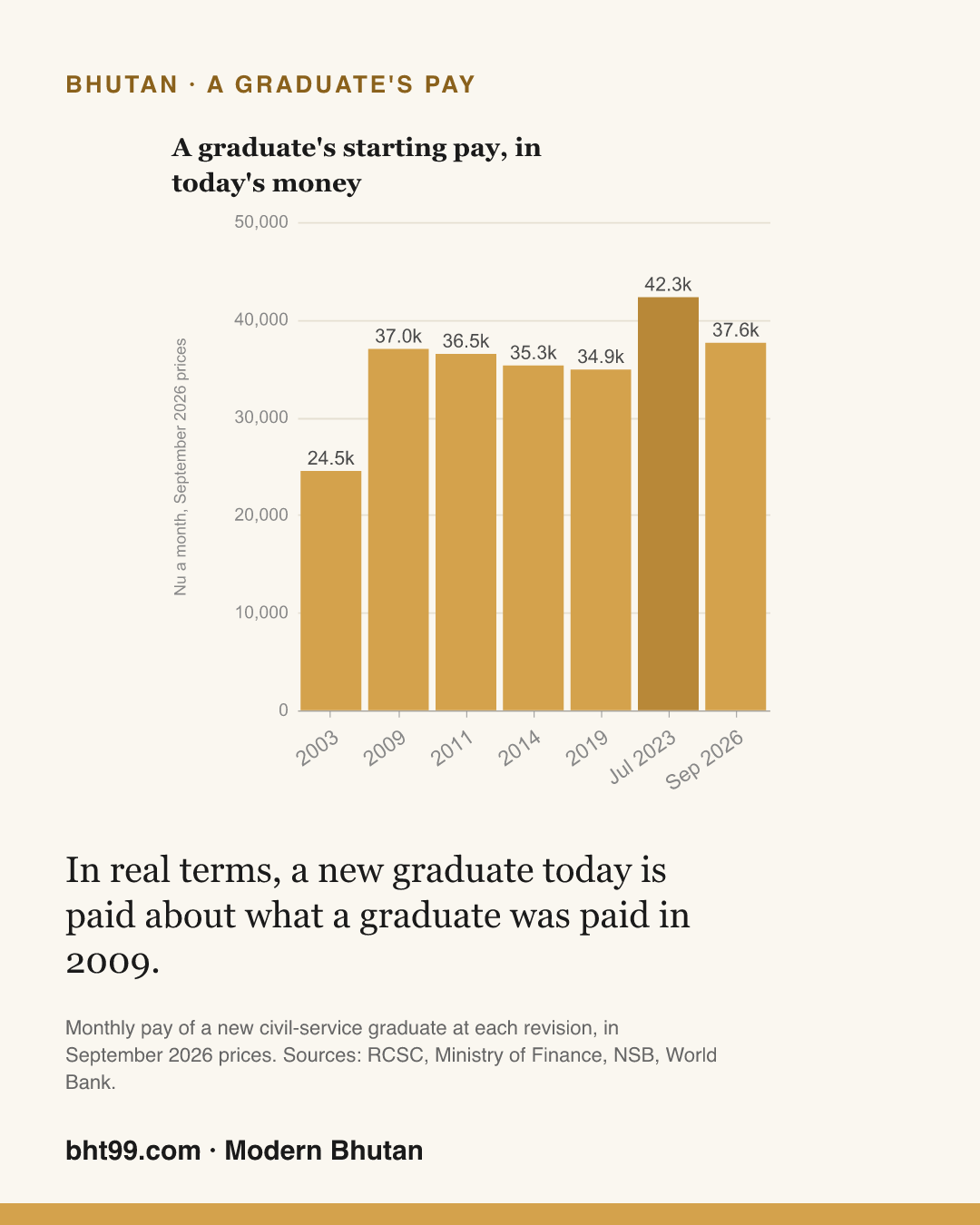
A new graduate in the civil service today is paid Nu 33,500 a month in basic pay plus the 2022 and 2023 revisions, about Nu 37,630 with the house rent allowance, and about Nu 40,600 with every regular monthly item. In today’s money, that is about where graduate pay stood in 2009, and above its level at every revision from 2011 to 2019. The full grade-by-grade table is on the pay-scale page.
The 2023 revision was the largest since pay commissions began in 2008, and took real starting pay to its highest level since at least 2003. Three years of inflation have brought it back down. Since July 2023, prices have risen 12.4%, so a graduate’s Nu 33,500 now buys what Nu 29,800 bought when the raise arrived. The month-by-month slide is in The 2023 Pay Raise, Three Years On.
What it must weigh
The commission’s brief comes down to four things. None of them points in only one direction.
1. Prices. Inflation ran between 5.4 and 7.7% from January to September 2026, after averaging about 2.8% in 2024 and 3.5% in 2025. The World Bank expects about 6% in 2026-27. At 6% a year, a salary that stands still loses about half a percent of its value each month; at the slower pace prices have risen since January 2026, under a fifth of a percent. Using official prices, the Momo Index puts the cost of standing still at about 12% of today’s pay already, and about 14 to 18% by mid-2027: Nu 4,900 to 5,900 a month on a new graduate’s Nu 33,500, simply to restore what the 2023 pay bought on the day it was paid.
2. People. The exodus has eased. The civil service recorded 16% attrition in 2022-23: of the nearly 5,000 who left, about 3,500 resigned by choice. (The catalogue’s entry on that year is The Year One in Six Walked Away.) By 2025-26 the RCSC put the rate at about 6%. That is still 1,504 voluntary resignations in a year. About 40% of those who left in calendar 2025 were aged 27 to 35, the years in which trained officers reach their most productive stretch. ICT officers have the highest attrition; nurses and engineers are also leaving in numbers. In the RCSC’s exit data, 42% left for further study and 29% for a better career or pay.
3. The pay bill. Pay and allowances cost the government Nu 25.6 billion in 2024-25: about 56% of current spending and 41% of domestic revenue. The 2023 revision alone added about Nu 6 billion a year. As a rough guide, one percent of the whole pay bill is about Nu 256 million a year. Headline percentages are usually applied to minimum basic pay, so a headline point costs less: about Nu 120 million in 2023. The Constitution requires recurrent spending to be met from the country’s own resources, and the 2026-27 budget aims to keep it within 78% of them. The Bill sets out the numbers.
4. The wider economy. Growth is strong and reserves stood at about USD 1.19 billion in July 2026, well above the constitutional threshold. Against that, the government is servicing more debt, and the World Bank expects recent tax cuts to lower tax revenue as a share of GDP over the medium term. A public pay rise also travels: state-owned enterprises and DHI companies revised their own pay after the 2023 round, and private employers competing for the same graduates feel it.
The task is to hold all four at once: pay that keeps the people the state has trained, within what the economy can carry, so that the next revision does not have to undo this one.
The performance incentive
The 2022 pay reform introduced the “clean wage”: a fixed basic pay plus a variable component that the government can review, which is where the 2022 and 2023 increases sit. The 2022 reform also provided for a performance-based incentive that could reach a full year’s basic pay, to be introduced once the performance-management system was in place, and the 2023 Act kept it in principle. The RCSC said in October 2026 that the incentive has not been paid, because of resource constraints; good performance is recognised through promotion, training and development instead. How variable pay should move between revisions is a question the Seventh Commission inherits.
What happens next
The commission reports, the Lhengye Zhungtshog considers its recommendations, and Parliament may attach conditions or modify them. When a new structure would take effect is for the government and Parliament to decide; the past rounds began on either 1 January or 1 July.
Until then, the most useful thing to watch is not a rumour about a percentage. It is the price index, published monthly by the National Statistics Bureau. Every month it rises, the cost of standing still rises with it.
A companion essay, on what a Bhutanese salary is worth against the world’s prices rather than local ones: The iPhone Index.
Background in the book: The 21 Times Rule, on why so many graduates queue for the civil service in the first place.
Sources
- Kuensel — Seventh Pay Commission starts work, report due in two months (10 October 2026)
- Business Bhutan — Seventh Pay Commission constituted: PM (10 October 2026)
- Business Bhutan — No financial performance incentives paid to civil servants under MaX system (10 October 2026)
- The Constitution of the Kingdom of Bhutan, 2008 (Article 30, the Pay Commission; Article 14, finance)
- Kuensel — earlier commissions: Seven-member pay commission formed (2013)
- Kuensel — Fourth Pay Commission established (2019)
- Kuensel — Fifth Pay Commission constituted (2022)
- Kuensel — Sixth Pay Commission formed (2023)
- Pay Structure Reform Bill of Bhutan 2022 (clean wage; performance-based incentive)
- Kuensel — Armed forces pay hike by 55–71 percent (26 July 2023)
- BBS — SOE pay revision of 46–72% (21 October 2023)
- BBS — DHI companies' pay revised by 60% of minimum basic pay (3 November 2023)
- BBS — civil-service attrition of 16% in 2022-23 (11 August 2023)
- Kuensel — Foreign reserves remain above threshold despite import pressures (8 August 2026)
- World Bank — Consumer price index, Bhutan (FP.CPI.TOTL), for prices before 2013
- Report of the Sixth Pay Commission (11 May 2023)
- Ministry of Finance — Pay Structure Reform & Pay Revision Notification (July 2023)
- Royal Civil Service Commission — Civil Service Statistics 2025
- BBS — civil-service attrition and resignations, FY2025-26 (7 October 2026)
- National Statistics Bureau — Consumer Price Index, monthly, to September 2026
- Ministry of Finance — Annual Financial Statements FY2024-25 (pay and allowances, current expenditure, domestic revenue)
- Ministry of Finance — National Budget Report FY2026-27
- National Statistics Bureau — Labour Force Survey Report 2025
- World Bank — Bhutan Macro Poverty Outlook (October 2026)